Welcome

I struggled to find PEM resources for my CT3 year, despite the variety of excellent resources out there. I hope this website will help point you in the right direction. I'm not a PEM expert, but am following the guidance CEM have issued (in the form of a syllabus) to put together this page. This page is not endorsed by CEM, and any mistakes are mine.

Please comment with corrections, additions and further suggestions.

All the information here is collected from the internet, and it might be out of date or inaccurate, so please use your judgement and adhere to your hospital's protocols. If you do notice any errors or omissions please comment so we can put them right!

To navigate, decide whether you want to start with a PMP or a PAP. You can then select which PMP or PAP you want to look at. You will then be taken to the summary page for that PMP, with links expanded topic collections. If you know what topic you want to look at already, click on the link on the right hand side.
Showing posts with label trauma. Show all posts

Sunday, 7 February 2016

Long Bone Fractures - in Children

Femoral fractures are uncommon, as considerable force is often required. There is often a history of a fall with the leg twisted awkwardly. In children fractures are more common at the physis, and we need to know about the "SALTER" classification. There is a bimodal distribution of femoral fractures - they are common in 2 - 4 year olds, and adolescents. We should always consider child abuse and non accidental injury, especially if the fracture presents in a patient before walking age.

Radiology of Note
The distal femoral epiphyses are normally present from birth to 18 -20 years
The patella ossifies between 3 - 6 years

Management
Support the leg with the hip and knee slightly flexed
Analgesia (intra-nasal very likely to be helpful)
Splintage
X-ray
Traction
Orthopaedic referral

Splinting
Most sources agree that splinting should be carried out as soon as possible, although practically this can be difficult.
< 3months:           Pavlick harness
>3 months/ 16kg:  Gallows traction
> 16kg:                Thomas splint (skin traction)

I have written a presentation that says all this with pretty pictures.

References
http://www.emdocs.net/pediatric-trauma-pearls-pitfalls/ 
http://www.orthobullets.com/pediatrics/4019/femoral-shaft-fractures--pediatric
http://www.tamingthesru.com/blog/acmc/traction-splints-applying-the-ktd-traction-splint 
http://www.ncbi.nlm.nih.gov/pubmed/23922601 
http://www.youtube.com/watch?v=DNyyYdtOX5Q 
http://www.sciencedirect.com/science/article/pii/S002013831500577X 
http://www.bestbets.org/bets/bet.php?id=1533 
http://www.sort.nhs.uk/Media/Guidelines/Wessexchildrensmajortraumaguidelines.pdf 
http://www2.rcn.org.uk/__data/assets/pdf_file/0004/608971/RCNguidance_traction_WEB_2.pdf
Emergency Care of Minor Trauma in Children. Ffion Davies et al. 
ABC of Emergency Radiology

Saturday, 7 September 2013

Trauma in Children

There are specific body systems affected in trauma. But what about trauma in general? Do we treat it exactly the same as we would in adults?

  • Tranexamic Acid
    There is a statement here from the Royal College of Paediatrics and Child Health. They acknowledge the lack of trial data, and suggest a pragmatic dosage of 15mg/kg loading dose (max 1g) over 10minutes, followed by 2mg/kg per hour.
  • FAST Scan
    This study suggests we shouldn't use FAST in children with abdominal trauma. This one says it has low sensitivity but high specificity. This one agrees. This blog makes it even more complicated - fluid in the pelvis can be normal in children!
  • Urinary catheters
    Inserting a catheter in a child is the same principal as in adults. There is a guide to paediatric catheter sizing here. Hopefully the paediatricians will help if a catheter is needed.

  • Courses
    There is a Children's Advanced Trauma Course. It seems to be run solely in Sheffield.

Please leave comments about what you think are important differences between paediatric and adult trauma. 

Wednesday, 21 August 2013

Chest Trauma in Children

"Know the likely injuries through different age groups including pulmonary contusion and flail chest"

Isolated significant chest trauma is rare in paediatrics, but is still the second highest cause of trauma related death in paediatrics (although whether the death was caused by the chest or by other injuries is difficult to tell). There is an excellent handbook from the Royal Children's Hospital in Melbourne which probably  tells you everything you need to know. There is a 2008 review in "Trauma" and a really nice overview presentation here.

Most chest injuries are caused by blunt trauma and  RTCs, and are normally associated with injuries elsewhere. The anatomy is similar to adults (excellent podcast here), but children are different - especially if they are younger:
  • Smaller
    • Traumatic forces distributed over a smaller mass
    • Smaller thoracic volume
    • Compact organs
  • Increased chest wall compliance
    • Ribs unlikely to break
    • Internal injuries likely with minimal external signs
  • Compensatory mechanisms may mask hypovolaemia
  • Mobile mediastinum
    • Airway injuries rare
    • Mediastinal shift may cause problems
  • Aerophagia is a common response in children
    • Causes reflex ileus
    • Leads to gastric dilation 

As in adults, there are six life threatening chest injuries to remember, remembered by the mnemonic "ATOM FC". These should be identified on the primary survey:
"ATOM FC"
 - Airway Obstruction
 - Tension Pneumothorax
 - Open pneumothorax
 - Massive haemothorax
 - Flail chest
 - Cardiac Tamponade

The Trauma journal review also reports there are six "hidden" but life threatening injuries:
-Cardiac contusions
-Aortic disruption
-Tracheobronchial disruption
-Oesophageal disruption
-Diaphragmatic tear
-Pulmonary contusion

We're hopefully pretty good at identifying the life threatening injuries. Often we suspect the "hidden" injuries. But how do we make the final diagnosis, especially as we know that we don't want to do unnecessary CTs on children.

This short presentation introduces some clinical decision rules to help you decide who needs chest imaging. Using a paper from the Annals of Emergency Medicine (which I can't access as it doesn't support Athens or Institutional Access) they suggest we only do a CXR in trauma if:
  • Low BP/Increased RR
  • Abnormal chest exam
  • GCS<15
  • Femur fracture
After trauma, most children I've seen have got an increased respiratory rate, so making sure we do a CXR for everyone doesn't seem unreasonable.  What about CT?

Pediatric Radiography have looked at how CT changes our management of paediatric patients. Again, I can only access the abstract:
235 children had a CXR and a CT done. In 1/3 CXR abnormal, and in 2/3 CT was abnormal.
Out of all the children, <5% got any chest procedure

<10% of kids with pneumothorax on CT got a chest tube
91% of CT findings were within 1cm of dome of liver --> visible on CT abdomen.

So this study would suggest that routinely doing a CT chest on all children may be unnecessary. Given that most of our treatment for chest injury is analgesia, and supporting ventilation, CT rarely changes management. Not all pneumothoraces are treated with a chest drain.
I'm not sure I'd be ready to chance hospital policy yet, but it is certainly something to think about! 

Lung Contusion
This is the most common chest injury in children, and can occur without chest wall injury.

Diagnosis:
-  Hypoxia
-  Consolidation on CXR (in 90% on initial CXR)
        - May be irregular and not conform to lobes
- CT scans pick up more scans
       - 38% of dogs experiencing blunt trauma had consolidation on CXR, compared to 100% on CTs


Treatment:
- Oxygen
- Analgesia
- Pulmonary toilet
- Ventilatory Support

Flail Chest
Flail chest is very rare, but can happen. The paraxodical chest movement caused by two or more rib fractures contributes towards respiratory distress. These often occur with pulmonary contusions. There is a very good explanation with some excellent pictures here.

Treatment
- Place the patient injury side downwards
- Intensive respiratory support
- Analgesia

Monday, 12 August 2013

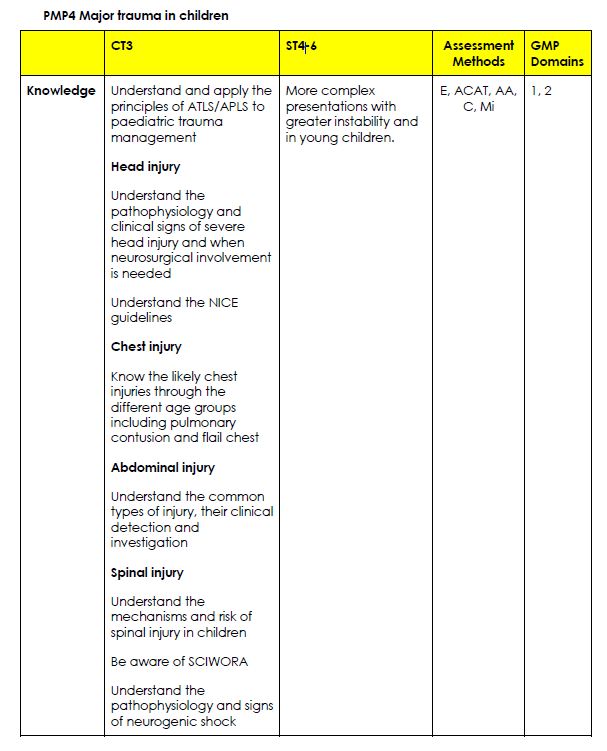
PMP4: Major Trauma in Children

This PMP has lots and lots of items in it. Having looked at this bit of the curriculum in detail, I'm skeptical as to whether attending APLS/EPLS really teaches you enough... What do you think?
Click here for all of the PMP4 / trauma posts.


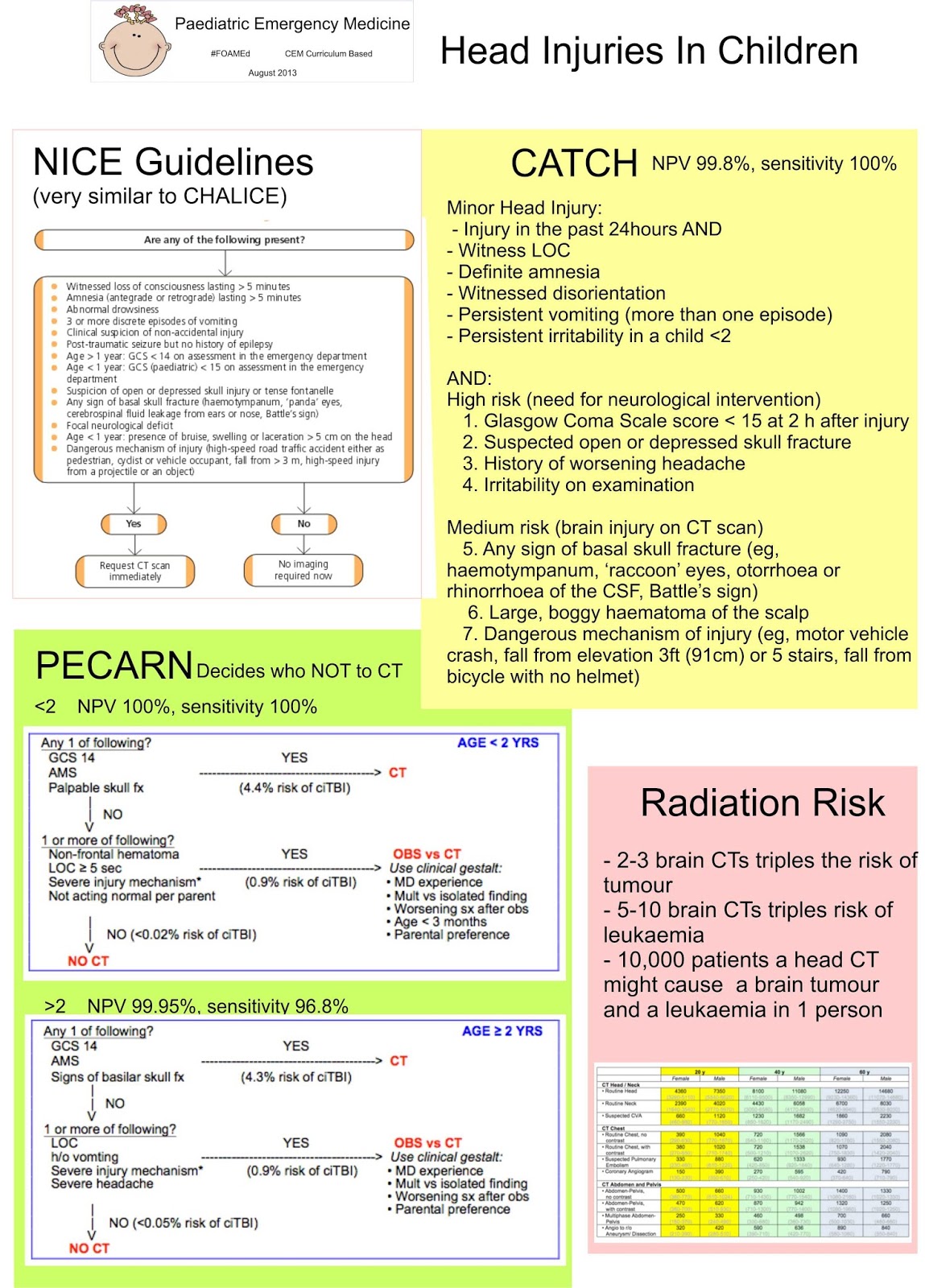
Head Injuries. For a detailed head injury post click here, and for a detailed radiation risk post click here:


Chest Trauma in children. For more posts, click here.


For more posts on abdominal trauma, click here.

For more posts on burns, click here.
For posts on spinal trauma click here
For posts on pelvic trauma click here