Welcome

I struggled to find PEM resources for my CT3 year, despite the variety of excellent resources out there. I hope this website will help point you in the right direction. I'm not a PEM expert, but am following the guidance CEM have issued (in the form of a syllabus) to put together this page. This page is not endorsed by CEM, and any mistakes are mine.

Please comment with corrections, additions and further suggestions.

All the information here is collected from the internet, and it might be out of date or inaccurate, so please use your judgement and adhere to your hospital's protocols. If you do notice any errors or omissions please comment so we can put them right!

To navigate, decide whether you want to start with a PMP or a PAP. You can then select which PMP or PAP you want to look at. You will then be taken to the summary page for that PMP, with links expanded topic collections. If you know what topic you want to look at already, click on the link on the right hand side.
Showing posts with label CPR. Show all posts

Monday, 12 August 2013

Cardiac Arrest Drugs

PMP 3 states we should:
"Understand the pharmacology, indications and contraindications, dose calculation and routes of administration of drugs used in resuscitation and the stabilisation of children in cardiac arrest."

Where better to start looking for resources on this kind of thing than in the anaesthetic literature?

Adrenaline
There is an anaesthetic FRCA tutorial here, which probably covers everything we need to know. It tells us similar things to LITFL. LITFL have a good summary here and here.
  • Naturally occurring catecholamine 
  • Hormone and a neurotransmitter
  • Broken down by monoamine oxidase (MAO) and catechol-O -methyltransferase (COMT).
  • Comes in 1:1000 strength (in vials) or 1:10000 (mini-jets)
  • Acts non selectively at all the adrenergic receptors (α1, α2, β1, β2, β 3)
    • At low doses the beta effects predominate - increase heart rate
    • At high doses the alpha effects predominate
  • Produces the flight or fight response (sympathomimetic)
  • Causes 
    • increased heart rate
    • increased contractility
    • vasoconstriction and vasodilation
    • bronchodilation
    • glycogenolysis
    • smooth muscle relaxation
  •  Side effects are normally because of overdose or inappropriate use. 
    • Dizziness
    • Palpitations
    • Tremour
    • Arrhythmias
    • Hypertension
    • Cerebral haemorrhage
    • Acute pulmonary oedema
    • Lactic acidosis
    • Hyperlactaemia - with long term use
    • Hyperglycaemia - with long term use
  • Caution
    • At all times: big effects on the cardiovascular symptoms
    • In patients with arrhythmias, hypertension or ischaemic heart disease
    • Care in patients taking Mono-Amine Oxidase Inhibitors
  • Uses
    • Cardiac Arrest: 1mg every 3-5 minutes, after 3rd shock. 10mcg/kg in children
      This is in the guidelines, but its use is still controversial
    • ROSC use 1: 100 000 to support BP if needed 
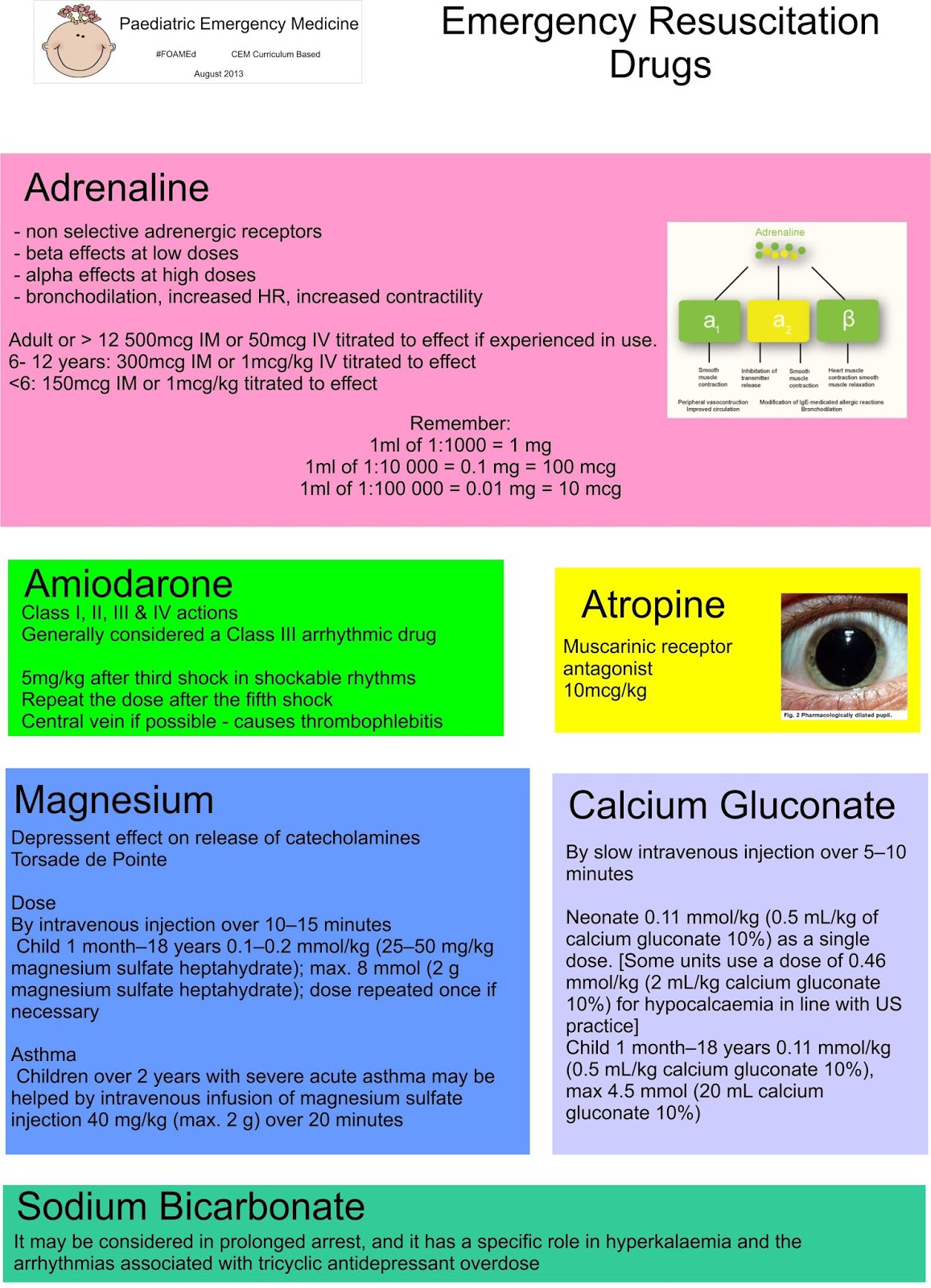
    • Anaphylaxis: Adult or > 12 500mcg IM or 50mcg IV titrated to effect if experienced in use.
      6- 12 years: 300mcg IM or 1mcg/kg IV titrated to effect
      <6: 150mcg IM or 1mcg/kg titrated to effect
    • Inotropic support: continuous infusion via central line with invasive BP monitoring
      • 4mg adrenaline diluted to 50ml in  saline or glucose
    • Severe croup: 
      •  0.5 ml/kg of a 1:1000 solution (maximum of 5 ml)
    • Topical or local vasoconstriction
      Remember:
      1ml of 1:1000 = 1 mg
      1ml of 1:10 000 = 0.1 mg = 100 mcg
      1ml of 1:100 000 = 0.01 mg = 10 mcg
Amiodarone
CV pharmacology has a good summary with some pretty pictures. LITFL has a good summary and a more pharmacology focused tutorial - they do state that efficacy of amiodarone in paediatric children hasn't been established.
  • Membrane stabilising anti-arrhythmic drug
  • Increases the duration of the action potential
  • Slows AV conduction
  • Mild negative inotropic effect
  • Causes peripheral vasodilation because of alpha-blocking effects
  • The solvent with it causes histamine release.
  • 25 - 60 days half life
  • Class I, II, III & IV actions
  • Generally considered a Class III arrhythmic drug
  • Dose:
    • 5mg/kg after third shock in shockable rhythms
    • Repeat the dose after the fifth shock
    • Central vein if possible - causes thrombophlebitis
  • Side effects
    • Pulmonary fibrosis
    • Thyroid problems
    • Can cause hypotension
    • Can cause Bradycardia and AV Block
    • Can cause liver enzyme elevations
    • May be arrhythmogenic
Atropine
There aren't so many summaries on atropine - probably because it's been taken out of the resus algorithm. There's something on CV pharmacology, LITFL summary and a page on the non resuscitation uses- Death Rattle.
  • Atropine is a muscarinic receptor antagonist and bind to muscarinic receptors. 
  • Stops ACh from binding
  • So stops the effects of vagal nerve activity on the heart
  • Administration of less than 500mcg in adults and less than 100mcg in children can produce a paradoxical bradycardia because of the central or peripheral parasympathomimatic effects of low dose.
  • Atropine rapidly crosses the placenta
  • Atropine crosses the blood-brain barrier
  • Side effects:
    • tachycardia
    • pupil dilation
    • dry mouth
    • urinary retention inhibition of sweating
    • blurred vision 
    • constipation
  • Contraindicated in patients with: 
    • glaucoma, 
    • pyloric stenosis and 
    • prostatic hypertrophy
  • Uses
    • Bradycardia - as per algorithm (adults and children 1 2 3)
      • May be caused by poisoning
      • Conduction disorder (pathway abnormality or Long QT)
      • Cardiomyopathy
    • Excessive secretions
  • Dose
    • 10mcg/kg
Magnesium
Magnesium is a panacea for everything at the moment. There is a summary article here, BNF entry here and a LIFFL summary. There are some good flashcards for Paramedics here. AAFP has got an interesting simply written article about magnesium.
  • Extracellular cation
  • Depressant effect on the release of catecholamines
  • Uses
    • Eclampsia
    • Torsades
    • Asthma
  • Contraindications
    • Heart block
    • Shock
    • Persistent hypertension
    • Hypocalcaemia
    • Myocardial damage
  • Cautions
    • Renal damage
    • Patients on digoxin
    • Use of CNS depressants or neuromuscular blocking agents
  • Side Effects
    • Hypotension
    • Sedation
    • Confusion
    • Bradycardia
    • Pruritis
    • Arrhythmias
    • Decreased deep tendon reflexes
    • Respiratory depression/paralysis
    • Drowsiness
    • Muscle weakness
    • Complete heart block
  • Dose
    • Torsade de Pointe
      • By intravenous injection over 10–15 minutes
      • Child 1 month–18 years 0.1–0.2 mmol/kg (25–50 mg/kg magnesium sulfate heptahydrate); max. 8 mmol (2 g magnesium sulfate heptahydrate); dose repeated once if necessary
    • Asthma
      • Children over 2 years with severe acute asthma may be helped by intravenous infusion of magnesium sulfate injection 40 mg/kg (max. 2 g) over 20 minutes
Calcium Carbonate
  • Used for: hyperkalaemia, hypocalcaemia, and over-dose of calcium-channel-blocking drugs
  • Dose for urgent calcium correction
    • By slow intravenous injection over 5–10 minutes
    • Neonate 0.11 mmol/kg (0.5 mL/kg of calcium gluconate 10%) as a single dose. [Some units use a dose of 0.46 mmol/kg (2 mL/kg calcium gluconate 10%) for hypocalcaemia in line with US practice]
    • Child 1 month–18 years 0.11 mmol/kg (0.5 mL/kg calcium gluconate 10%), max 4.5 mmol (20 mL calcium gluconate 10%)
Sodium Bicarbonate  
From the PALS algorithm:
"The best treatment for acidaemia in cardiac arrest is a combination of effective chest compression and ventilation (good quality CPR). Administration of sodium bicarbonate generates carbon dioxide, which diffuses rapidly into the cells, exacerbating intracellular acidosis if it is not rapidly cleared via the lungs.
It also has the following detrimental effects:
  • It produces a negative inotropic effect on an ischaemic myocardium.
  • It presents a large, osmotically active, sodium load to an already compromised circulation and brain.
  • It produces a shift to the left in the oxygen dissociation curve further inhibiting release of oxygen to the tissues.
The routine use of sodium bicarbonate in cardiac arrest is not recommended. It may be considered in prolonged arrest, and it has a specific role in hyperkalaemia and the arrhythmias associated with tricyclic antidepressant overdose. "
  • Dose

    • By slow intravenous injection of a strong solution (up to 8.4%), or by continuous intravenous infusion of a weaker solution (usually 1.26%)
    • An amount appropriate to the body base deficit


Tuesday, 6 August 2013

Cardiac Arrest in Children - aetiology

There are two types of cardiac arrest in adults, and children.

Primary Cardiorespiratory Arrest: due to an underlying cardiac arrhythmia (eg VF or VT) is more frequent in adults. The onset is often acute and unpredictable. Immediate defibrillation is needed.

Secondary Cardiorespiratory Arrest is more common in children and is because the body can't deal with the underlying injury or illness.
The pre-terminal rhythm in children is often bradycardia which leads to asystole or PEA - non shockable rhythms.

The outcome from cardiorespiratory arrest in children is poor, especially if there is a prolonged duration. Compared to adults, children are physiologically different but like adults, early recognition of the seriously ill child can prevent sudden death.

Some conditions are more likely to affect children than adults, and more likely to cause their arrest:
Croup: remember a narrower tracheal tube than would normally be expected may be required.
Epiglottitis: you must keep the child calm until the airway is secure.
Bronchiolitis
Coma
Seizures
Anaphylaxis: give adrenaline as quickly as possible

Drowning, electrocution and hypothermia can also affect children, and cause cardio-respiratory arrest. In an arrest situation, the standard CPR algorithms should be followed.

Survival rates remain poor, with survival rates of 0 - 38% quoted in the literature.

Monday, 5 August 2013

Paediatric Resuscitation

Most people learn by doing, whether their "doing" is simulation, or real life. Given the thankful infrequency of paediatric arrests, we must rely on simulation. I would strongly recommend you practice paediatric resuscitation simulations, making them as realistic as possible, to supplement your theoretical knowledge. I've heard that one children's hospital runs a mock paediatric arrest weekly, and it is very helpful.

Course wise, either APLS or EPLS is accepted. Most people I've spoken to prefer the APLS course as they syllabus is broader. I've not done both of them so I can't comment, but I enjoyed my course.

Guidelines
American Heart BLS guidelines
American Heart ALS guidelines
American Heart ALS and BLS
American Heart Summary
Anaethetists Update
Resus Council Guidelines

Issues
This blog has a look at what goes wrong in a paediatric arrest. With a link to a formal study, they conclude that "issues regarding equipment familiarity/use/misuse, failure to check BSL, and drug errors. Calculations of drug doses were difficult under stress. Failure rates in some of these domains exceeded 50%.

Drug dosing is difficult. Multiple smart phone apps exist - I like PalmPedi, despite the American-ness (if you buy PalmPedi consider getting PalmEM - reviewed on LITFL instead, as PalmED encorporates PalmPedi). This Australian website is nice and clear. We'll blog about drugs later.

Word of mouth suggests that "WET FAG" is no longer used as an acronym, and "WET FLAG" is more common instead. I do try and memorise all of these doses, but do like to be able to swiftly check them. I do not trust my phone to have signal or battery, and other Clinicians are often busy - so I rely on paper versions instead.

Parents - in or out?  In my experience they want to be in, and it is useful to have someone explaining things to them. They don't alter efficacy of the resuscitation effort.

Paeds arrest in trauma? Survival rates aren't good.

And debriefing afterwards is good, even if the resus is successful. Remember to carefully document - especially as you may have caused rib fractures, which may be later attributed to non accidental injury.

The Algorithm
Apart from doses, the algorithm is pretty much the same as for adults with a few key differences:
 - Start with 5 initial rescue breaths
 - CPR ratio 15:2

There are plenty of similarities:
 - No atropine unless bradycardic
 - Sodium bicarbonate only recommended if prolonged arrest, or associated with hyperkalaemia or TCA overdose
 - Continuous compressions encouraged.
 - After ROSC, titrate oxygen to saturations


Newborn Life Support

Having to perform NLS is rare, but is an easy exam scenario. The NLS course is a very useful one day course to attend. If you can't get on an NLS course, I'd recommend reading the NLS course manual - it has many useful pictures and tips. It is worth remembering that the N in NLS stands for "Newborn" and NOT "Neonatal". This means that if you have a poorly baby who is even six hours old, they are not a new born, so APLS guidelines should be used, not NLS.

If you look hard enough, there are quite a few neonatal life support resources.
The resus council protocol is here: Newborn Life Support.
The American Heart Association guidelines are here.

Life in the fast lane have a very useful (no pictures, so quick to load) summary here with the SMACC conference video on newborn resuscitation. AAFP also has guidelines here.  PedEMMorsels has a very matter of fact summary here. The anaesthetists have had their own update here. WikiEM also has a very thorough summary. Academic life in EM has some good videos, supplemented with pictures of stick men!

Make sure you know your hospital's protocols. Many hospitals have a seperate Neonatal resuscitation team, as well as the Paediatric resus team.
If you have a resuscitaire in your department, check that you know how to use it. If you don't have a resuscitaire, where is your nearest?


And if you were wondering - yes, you can use an LMA in new born resus - sanscrit and resus.me have the answers.

PMP3: Cardiopulmonary Resuscitation

Paediatric Arrests don't happen often - but when they do we should be ready. The curriculum and summaries are on this page.
To have a look at the detailed posts and links for each topic, please go here.


The ALiEM summary on hypothermia is so good there's no point reinventing the wheel.For more hypothermia blog posts, please click here.

For more NLS blog posts, please click here.


For more PLS blog posts, please click here.


For more electrocution blog posts, please click here


For more blog posts on arrest drugs, please click here.


There are also posts on:
Venous Access 
SIDS
Drowning